

Numbers listed in parentheses indicate ages for each class; letters indicate the session(s).
SEASHORE LIFE (7-8) A, B
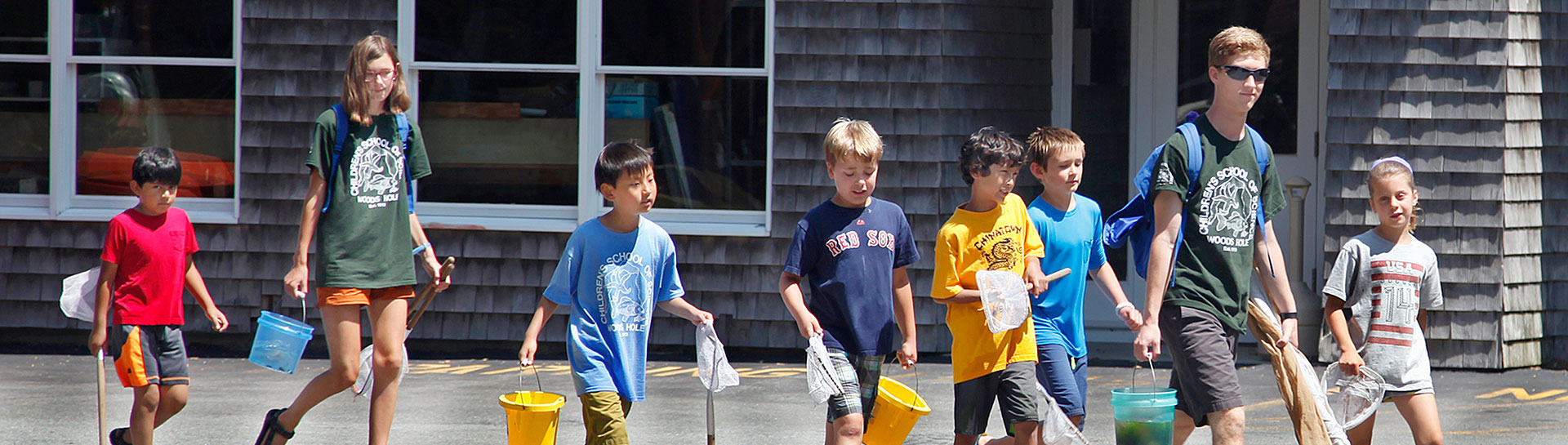
Students will explore local beaches and salt marshes to observe and learn about marine life and coastal processes. Activities will include the study of seashore communities, learning to identify common invertebrate phyla, collecting organisms in intertidal environments, setting up classroom aquaria, conducting experiments, and completing art projects.
PATTERNS IN NATURE (7-8) B
Where can we find patterns in nature? Everywhere! We’ll look at symmetry, spirals, branching, waves, tessellations, polka dots, and stripes. We’ll explore nature to find patterns in fields, woods, ponds, backyards, and at the beach. We’ll collect objects from nature and have fun with art projects that will help us understand patterns and answer questions like: Why are beehives full of hexagons? How does it help a Killifish to have stripes? Why are some baby animals covered in spots?
WOODS, PONDS, AND FIELDS (8-9) A, B
Students will learn about the natural history of animals and plants that live in terrestrial and freshwater environments. Through explorations in the field, creative projects, collections, and by setting up terraria and aquaria in the classroom, the students will be introduced to concepts of entomology, botany, ornithology, herpetology, limnology, and ecology.
ANIMAL BEHAVIOR (8-9) A, B
Animals are born with instincts. They already know how to do certain things, like build nests, find food, and avoid predators. Animals can also learn to do new things. Herring Gulls learn to drop clams to crack them open by watching other gulls do it. Mice can learn their way through a maze. In this class, we will observe animals to learn about what they do and why they do it, and we will set up some experiments to demonstrate animals’ behaviors.
MARINE BIOLOGY (9-10) A, B
This is a diverse, field-oriented course in which students will visit rocky shores, sandy beaches, and marsh ecosystems to explore and observe the organisms that live there. The students will collect animals and plants to learn to identify them and learn about how they live. In the classroom, students will keep aquariums for a better look at the animals they find. Microscopes and dissections will be used for close study.
GULF STREAM ORPHANS (10-11) B
Gulf Stream Orphans are what we call the tropical fish that are swept north beyond their native range by the Gulf Stream in the summer. In this class, we will learn about the relationship between the Gulf Stream, climate, water temperatures, and the distribution of marine species. We’ll do a lot of collecting at local docks, beaches, and salt marshes to look for GSOs as well as other non-native animals and plants that arrived here from around the world. We’ll learn about how they got here and what effects they have on local environments and on native species. We’ll keep a record of the GSOs we find and submit our data to the GSO Project: www.gsoproject.org
ART, SCIENCE, AND NATURE (10-11) A
This course blends science, nature, and the visual arts. Students will use various materials to create forms of art while learning about ecological relationships between organisms and local natural environments. Students will explore different habitats along the seashore, in the woods, in freshwater wetlands, and in the suburban backyards of Woods Hole. Through sketches, sculptures, and other projects, students will showcase the connections among animals, plants, and their environments, as well as our interactions with them.
SEAWEEDS (10-11) A
Did you know that we most likely consume some form of seaweed every day without even knowing it? Over the course of three weeks, students will immerse themselves in hands-on activities that cover such topics as algae form and function, growth and light, photosynthesis and respiration, eutrophication and pollution, ocean acidification, and aquaculture. Students will learn how to identify local species using identification guides, examine ecological interactions between seaweeds and their surroundings, press seaweeds, eat seaweeds, and design a kelp farm in a fish tank.
HERPETOLOGY (10-11) B
Herpetology is the study of reptiles and amphibians. Both are cold-blooded animals with backbones (vertebrates). Reptiles have scales and they hatch from eggs that are laid on land or carried in the mother’s body. Amphibians have smooth skin and their tadpoles hatch in freshwater. In this class, we’ll learn to identify local species that can be easily found and seen, like frogs, toads, salamanders, snakes, and turtles. We will learn about the habitats in which they are found and each animal’s development, anatomy, form, function, evolution, adaptations, and feeding strategies.
PLANTS AND INSECTS (10-11) A
They are all around us! Wouldn’t you like to get to know some up close? Get to know plants and insects. Learn about their special co- adaptations, life cycles and habitats through daily field work, observation, collection, microscopy and more. We’ll raise larvae on their host plants, visit local science labs, make plant dye and fabric, and of course forage responsibly. Two great “kingdoms“ in one course.
INVERTEBRATE ZOOLOGY (10-11) B
Invertebrates are animals without backbones. They make up 94% of the world’s animal species. Field trips to beaches, ponds, fields, woods, and backyards will give the class the chance to collect animals to bring back to the classroom for close study and observations of anatomy, reproduction, feeding, and behavior. Each week will focus on different groups of animals.
First Week – soft invertebrates (sponges, jellies, etc.)
Second Week – molluscs, sea stars, sea urchins
Third Week – arthropods (insects, spiders, crabs, etc.)
(For this class only, a student can sign up for any one or two weeks, or all three weeks. )
COMPARATIVE HABITATS (11-12) A
An animal’s habitat is the specific location where it lives and where it finds what it needs to survive, including food and shelter. We will learn about the differences between habitats, environments, and ecosystems by exploring the seashore, marshes, ponds, fields and forests to look closely at the animals and plants that live there to learn about how they are adapted to live in their particular habitats.
METEOROLOGY (11-12) A
Weather is easy to study because it’s around us every day and is always changing. What is weather, what causes it, and how can we predict it? Solar energy input, temperature differences, and pressure variations in the atmosphere drive the weather. Students will learn about the components of weather, and they will use and construct instruments that will demonstrate concepts and collect data on temperature, atmospheric pressure, wind speed and direction, humidity, precipitation, and cloud cover. Students will become adept at identifying cloud types and recording data, looking for patterns in changing weather conditions—and maybe even predicting what tomorrow’s weather will be without consulting the internet!
WHALES, SEALS, & SEA TURTLES (11-12) B
Students will learn to identify the marine mammal and sea turtle species most common to our waters. Whales, dolphins, porpoises, seals, and sea turtles can be found all around Cape Cod. Some can be easily seen from shore, even in Woods Hole. We’ll look at their adaptations for life in the ocean. We’ll learn about the many threats these animals face from ocean debris—like fishing line, nets, rope, and plastic bags—and about the great dangers posed by ship strikes and boat propeller injuries. Local biologists who work in the field of marine animal rescue and rehabilitation will visit us in the classroom, and we will have the chance to visit animals in rehab facilities.
ORNITHOLOGY (11-12) B
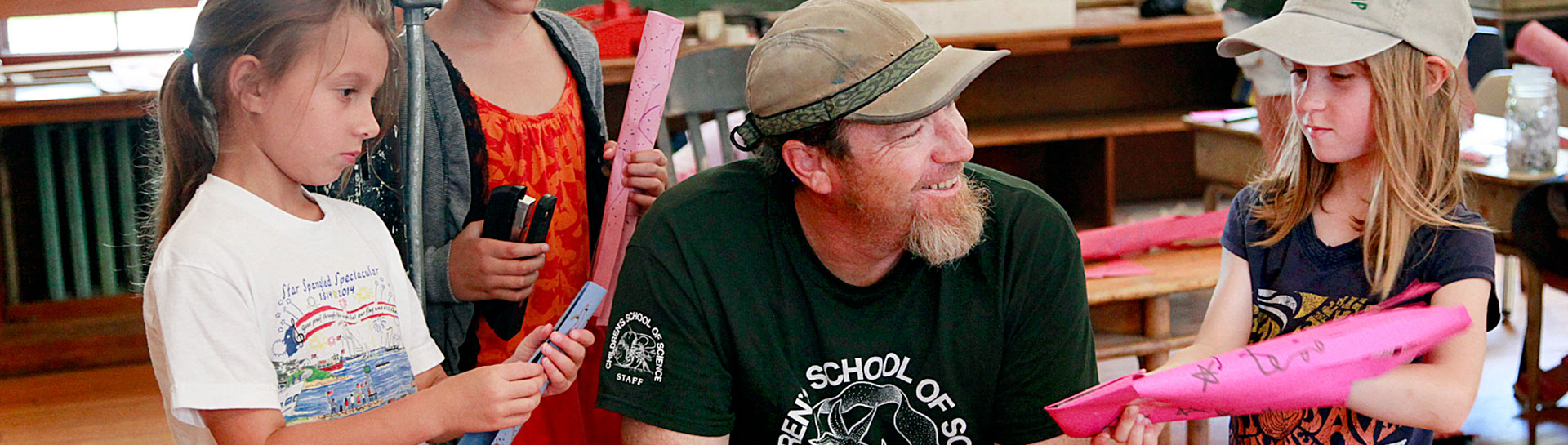
Fascinating bird facts: Birds are dinosaurs. Birds’ bones are hollow. Blue Jay feathers aren’t really blue. This course is designed to give students a basic understanding of bird biology as well as the ability to identify local birds by field marks, voice, and song. Students will learn life histories, comparative morphology and coloration, and behavior. Activities will include field exploration and observation of nest sites, using paper airplanes to demonstrate how wing shapes affect bird flight, and making quill pens.
OCEANOGRAPHY (11-12) B
Students will learn about the physical and chemical properties of seawater and take measurements of salinity, temperature, and pH. We’ll learn about ocean zonation, beach profiles, wave formation, and how ocean currents are affected by the earth’s rotation. We’ll collect data on tidal currents and tides and learn how they are caused by the interaction of Earth, the sun, and the moon. Students will investigate how changes in ocean chemistry, whether due to natural processes (such as biological activity or geology) or caused by human activities (such as pollution), may impact both marine and terrestrial life.
NAUTICAL SCIENCE (12-13) B
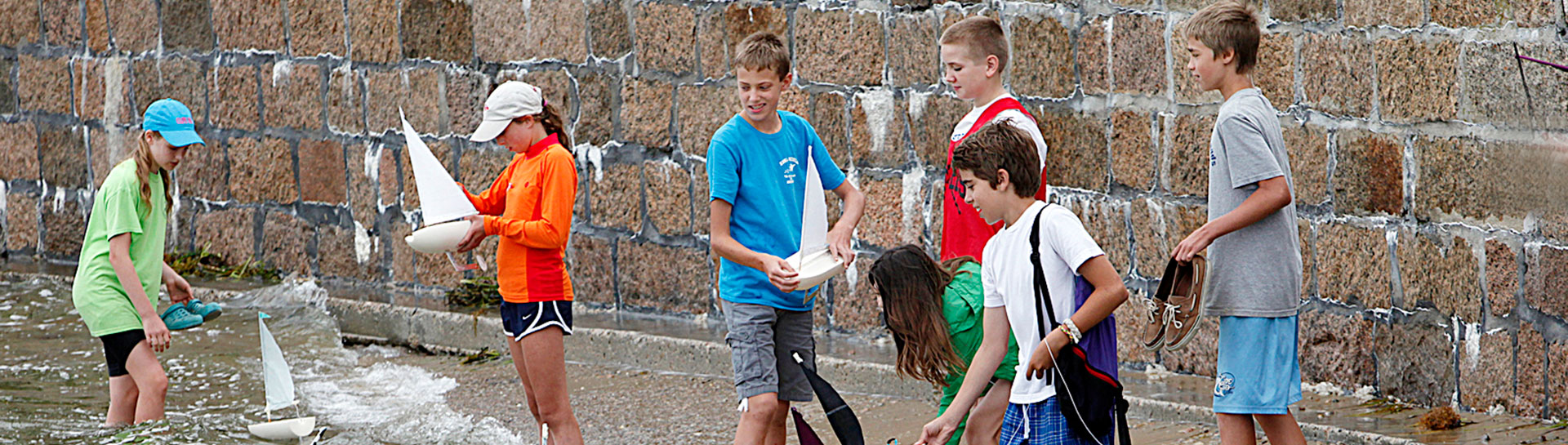
Students will explore boat design and build a seaworthy model boat, learn to navigate by chart and compass, experiment with the principles of buoyancy and displacement, and delve into nautical terminology and practical seamanship. Classes will take trips to the working waterfront and by boat through Woods Hole Passage.
INTRODUCTION TO FILM PHOTOGRAPHY (12-13) A, B
Students will learn the science behind photography and how to use a 35-mm SLR film camera. The class will learn to develop film and use enlargers in the darkroom to enlarge and print photographic images. They’ll learn about the chemical reactions that take place when film and photo paper are exposed to light, and about how darkroom chemicals like developer, stop bath, and fixer work. Students will explore how to artistically capture nature through a lens. CSS will provide each student with an SLR film camera to use for the class. Space is limited to 10 students. Materials Fee: $40
ICHTHYOLOGY (12-13) A, B
Students will learn to fish using different baits and lures, as well as by setting traps and using seines. They’ll study the characteristics of fish species that are found in local North Atlantic and freshwater habitats, and learn about fish anatomy and the adaptations they have developed for life and survival in aquatic environments.
MICROBIAL LIFE (12-13) A
How many organisms live in a single drop of pond water? Or in a teaspoon of soil? To find out, students will gain skills in microscopy while observing and learning about bacteria, protists, microfungi and other microorganisms. Discover how they survive and thrive and how they change and shape environments. Students will collect samples in local habitats to bring back to the classroom for study.
EELGRASS ECOLOGY (13-14) A
In this course, students will explore eelgrass habitats in shallow bays and estuaries while learning how these meadows support fish, crabs, snails, and many other marine organisms. This will be a very hands-on, exploratory class in which students measure eelgrass growth, observe the animals that depend on it, and test how light, tides, and water quality affect these habitats. Students will design small experiments, practice species identification, and use sketches and field notes to record what they discover. We will also learn about the science of ecological restoration and discuss how human activities such as pollution and boating can impact eelgrass communities. Most of our time will be spent outdoors, developing practical research skills and a deeper appreciation for the vital role eelgrass meadows play in coastal ecosystems.
ROBOTICS/ROVs (13-16) A, B
Students will focus on the technical, economic, and environmental aspects of real-world marine engineering and electronics. Through project design and data analysis, students will explore principles such as buoyancy, propulsion, and energy. There will be frequent field trips to Woods Hole labs to observe and learn about real-world ROVs (remotely operated vehicles). Students will build and test functional underwater ROVs. Materials Fee: $40
COASTAL PROCESSES AND PROTECTION (13-16) A
This course is aimed at examining the processes that shape a coastline, and it will consider ways to protect it. Students will travel to the beach and learn how to measure its topography, examining how hard structures like jetties may impact the shape of a coastline. Students will analyze the effectiveness of different types of coastal protection and create a plan to defend Woods Hole from rising seas!
FIELD GEOLOGY AND MAPPING (13-16) B
Did you know that Cape Cod and the Islands were formed by a huge ice sheet over ten thousand years ago? Students will be introduced to the geological history of Cape Cod through field work, experiments, and classroom modeling. The class will visit and observe landforms that the glaciers left behind when they retreated. Field trips will take us to see cliffs, outwash plains, moraines, knob-and-kettle terrain, and kettle holes, and learn about the processes that formed them. Please be aware that there may be additional field trips or slightly longer trips to visit landforms that are beyond what we can see right in Woods Hole.
BIOLOGICAL ILLUSTRATION (14-16) B
Illustration can be a useful and beautiful method of recording information. In this class, we will become familiar with basic techniques of biological illustration, while examining the structure, anatomy, and function of local organisms. This course will also compare historically important methods of illustration with modern techniques such as photomicrographs and data-based animations.
EVOLUTION AND BIODIVERSITY (14-16) A
How do organisms evolve to survive across diverse habitats, and what can their traits tell us about their ecological roles? In this course, students will explore the processes that drive adaptation and evolution in marine (and some terrestrial) organisms, with a focus on how both biotic and abiotic factors shape diversity. Through hands-on investigations in local WH coastal ecosystems, students will observe and compare physical traits, behaviors, and life-history strategies to infer evolutionary relationships and ecological functions. The course emphasizes making predictions from real-world observations and connecting form to function across a wide range of marine species.
ADVANCED MARINE BIOLOGY (14-16) A, B
Through hands-on experience, students will delve into the biology and ecology of marine vertebrates and invertebrates, their evolution and classification, anatomy and physiology, behaviors, and habitats. This course will include snorkeling field trips to explore different marine ecosystems around Woods Hole. Students must provide their own mask, snorkel, and fins. A swim test will be administered requiring students to swim 50 ft and tread water for 2 minutes. Space is limited to 14 students.
BEHAVIOR AND NEUROSCIENCE (14-16), B
Students will explore how the nervous system controls behavior through hands-on experiments with invertebrates (crabs, earthworms) and human subjects. Each class includes live electrophysiology recordings using Backyard Brains equipment — using similar tools to those used in university neuroscience labs. No prior biology background required. Students leave with real data, real questions, and a genuine feel for what it means to do neuroscience. Topics include: neurons and electrical signals, muscle control and reflexes, sensory systems, and the neuroscience of behavior. This is an active research-style course. Generously supported by a grant from the Grass Foundation.